PolicyFinance
Sitharaman tells World Bank to judge private capital drives by jobs, not money raised
At the Development Committee in Bangkok, the Finance Minister also asked for a full review of the World Bank's governance indicators, which India has long disputed.
Key points
- Nirmala Sitharaman spoke for India at the 114th Development Committee plenary in Bangkok on Thursday.
- She said private finance should be measured by jobs created and productivity, not by volume.
- India renewed its demand for a review of the Worldwide Governance Indicators.
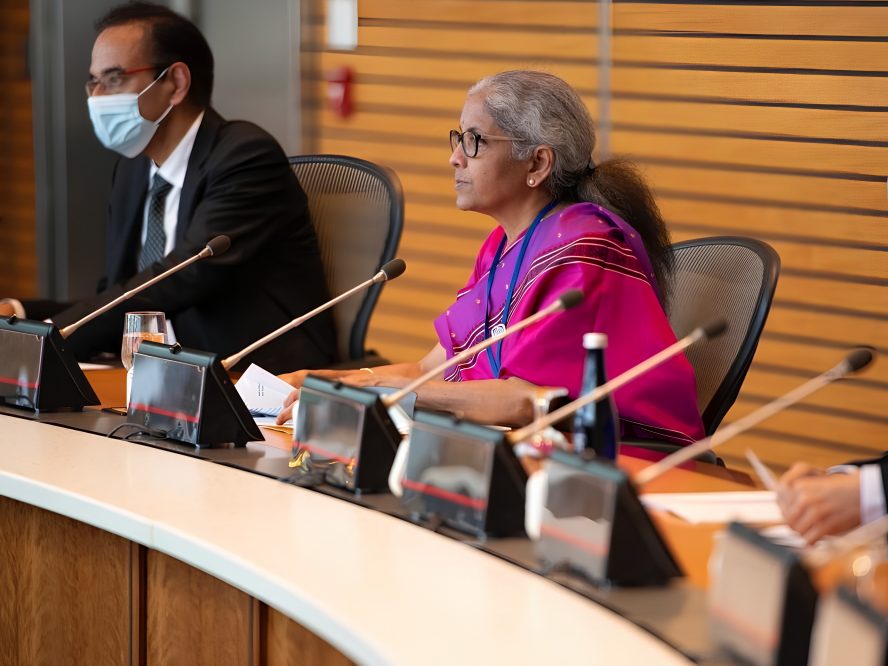
Finance Minister Nirmala Sitharaman told the World Bank’s top ministerial forum on Thursday that efforts to pull private money into developing countries should be judged by the jobs they create, and pressed again for an overhaul of the Bank’s governance rankings.
Sitharaman, who attended as India’s Governor at the World Bank, spoke at the 114th plenary of the Development Committee in Bangkok, held during the IMF and World Bank Annual Meetings that run until 18 October. The agenda was “Private Capital Mobilisation and Jobs”.
“At a time of growing energy market stress, trade fragmentation, climate pressures, and rapid technological change, productive and better-paid jobs remain the most effective pathway to poverty reduction and shared prosperity,” she said.
Six points from India
Sitharaman set out six points. The first was that jobs need a whole system around them. “Jobs require ecosystems, not isolated interventions,” she said, listing macroeconomic stability, good infrastructure, simple regulation and wide access to finance and skills. She pointed to India’s experience with large-scale physical and digital public infrastructure and financial inclusion.
She said the private sector must stay at the centre of development, and that “most jobs will be and should be created by private enterprises”, with small businesses and startups playing a big part. But the yardstick had to change. “Success should be measured not by the volume of financing mobilised, but by outcomes: jobs created and rise in productivity,” she said.
She asked the Bank’s lending arms, IBRD, IFC and MIGA, to work more closely together and to move faster on the World Bank Group’s guarantee platform. Developing economies, she said, are short of risk capital, and guarantees are among the best tools to draw in private investors.
Her third point was cost. The Bank, she said, must stay competitive on pricing, using local currency loans, stronger guarantees and lower transaction costs, with affordable financing at the core of its strategy for middle-income countries.
She also wanted the Bank’s research and advice aimed at market failures in urbanisation, tourism, farm exports and critical minerals, and said artificial intelligence “deserves much greater attention” for what it could do to build state capacity in poorer countries.
The governance rankings
The sharpest line was on the Worldwide Governance Indicators, the World Bank’s composite scores of how countries are governed. India has objected to them for years.
“We reiterate our longstanding concerns regarding Worldwide Governance Indicators and similar composite assessments,” Sitharaman said. She called for “a comprehensive review and revision of existing methodologies” so that they are transparent, objective and based on evidence, and said this was essential to “preserving the integrity of the Bank’s knowledge products”.
She closed by asking for a stronger voice for developing countries in how the Bank is run. “The ultimate measure of success is whether reforms help countries create jobs, raise productivity, reduce poverty, and improve living standards,” she said.
The Annual Meetings continue in Bangkok through the weekend.
The documents
- 2026 Annual Meetings, BangkokWorld Bank, 15 October 2026