Science & TechSpace
Japan readies MMX probe to bring back the first samples from a moon of Mars
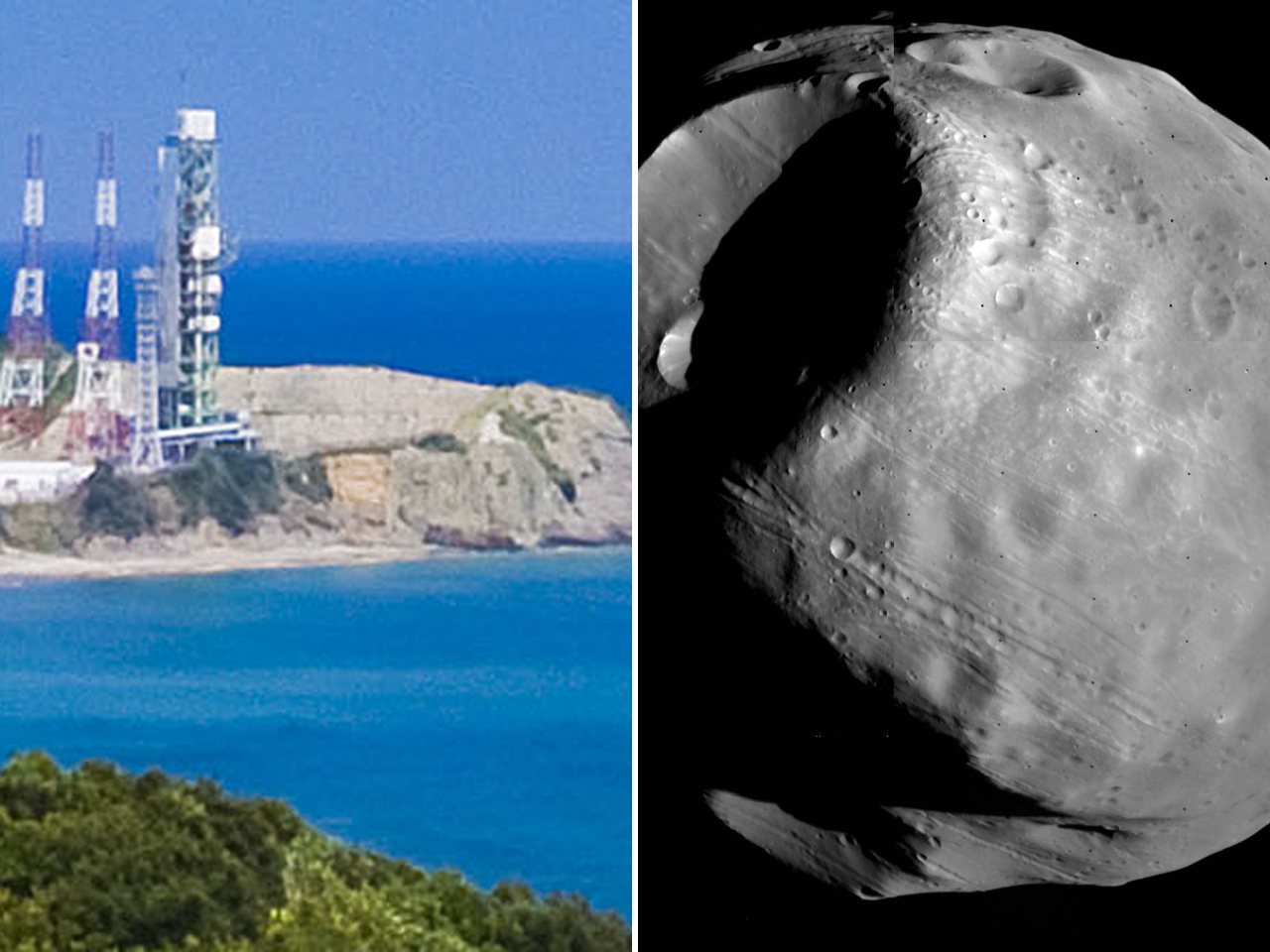
JAXA's Martian Moons eXploration mission is due to lift off on an H3 rocket from Tanegashima early on Tuesday morning Japan time, aiming to return Phobos soil to Earth in 2031.
Key points
- MMX is due to launch at 4:41 am JST on Tuesday, 20 October (1:11 am IST) on Japan's H3 rocket.
- It aims to land twice on Phobos and bring back more than 10 grams of its surface.
- NASA has supplied two instruments and will keep about 15% of the sample.
Japan is preparing to launch a spacecraft that aims to do what no mission has done before: land on a moon of Mars, scoop up its soil and fly it back to Earth.
The Japan Aerospace Exploration Agency (JAXA) has scheduled the launch of its Martian Moons eXploration (MMX) probe for 4:41 am Japan time on Tuesday, 20 October, which is 1:11 am in India. It will fly on the tenth flight of the H3 rocket from the Tanegashima Space Center.
If all goes to plan, MMX will reach Mars in August 2027 and stay around Phobos until 2030. A capsule carrying the samples is due back in 2031, with recovery planned in Australia.
What the mission will do
MMX is designed to answer an old question: where Phobos and its sister moon Deimos came from, and what they can tell scientists about the early history of Mars.
“Phobos and Deimos may be the remains of a massive impact on Mars,” said Tom Statler, NASA’s programme scientist for the mission.
The spacecraft will enter what JAXA calls a quasi-satellite orbit around Phobos, study it in detail and then make two soft landings to collect material. JAXA’s goal is to bring back more than 10 grams of regolith, the loose rock and dust on the surface. Deimos will be observed in the final phase before MMX leaves for home in 2030.
Its payload list runs to about 14 items, including a lidar, a rover and two sampling systems. JAXA’s own C-Sampler will pull cores from a few inches below the surface.
NASA’s part
NASA has contributed two pieces of hardware. MEGANE, a spectrometer built by the Johns Hopkins Applied Physics Laboratory, will measure gamma rays and neutrons coming off Phobos to work out what elements its surface is made of. The P-Sampler, built by Honeybee Robotics, a Blue Origin company, is fixed to one of the landing legs and uses bursts of high-pressure nitrogen to collect surface material.
NASA’s Deep Space Network will help track and talk to the spacecraft. NASA will receive about 15% of the returned sample, to be curated at the Johnson Space Center in Houston.
“The samples from MMX will bring forth paradigm-shifting science on the Mars system for generations to come,” said Nicky Fox, who heads NASA’s Science Mission Directorate.
What happens next
If it succeeds, MMX would be the first mission to bring back material from anywhere in the Martian system. JAXA has not announced any change to the launch date. In the United States, the launch falls on Monday afternoon, at 3:41 pm Eastern time.
The documents
- NASA to Help Unlock Mysteries of Mars' Moons in Upcoming MissionNASA, 15 October 2026
- What's MMXJAXA, 17 October 2026