Science & TechSpace
Japan's MMX probe lifts off for Mars, aiming to bring home the first pieces of Phobos
An H3 rocket launched the Martian Moons eXploration spacecraft from Tanegashima early on Tuesday Japan time, and JAXA confirmed it had separated from the upper stage and was on its way to Mars.
Key points
- MMX separated from the H3 rocket's upper stage and is on a path to Mars.
- The spacecraft is due to reach Mars in 2027 and land on Phobos twice.
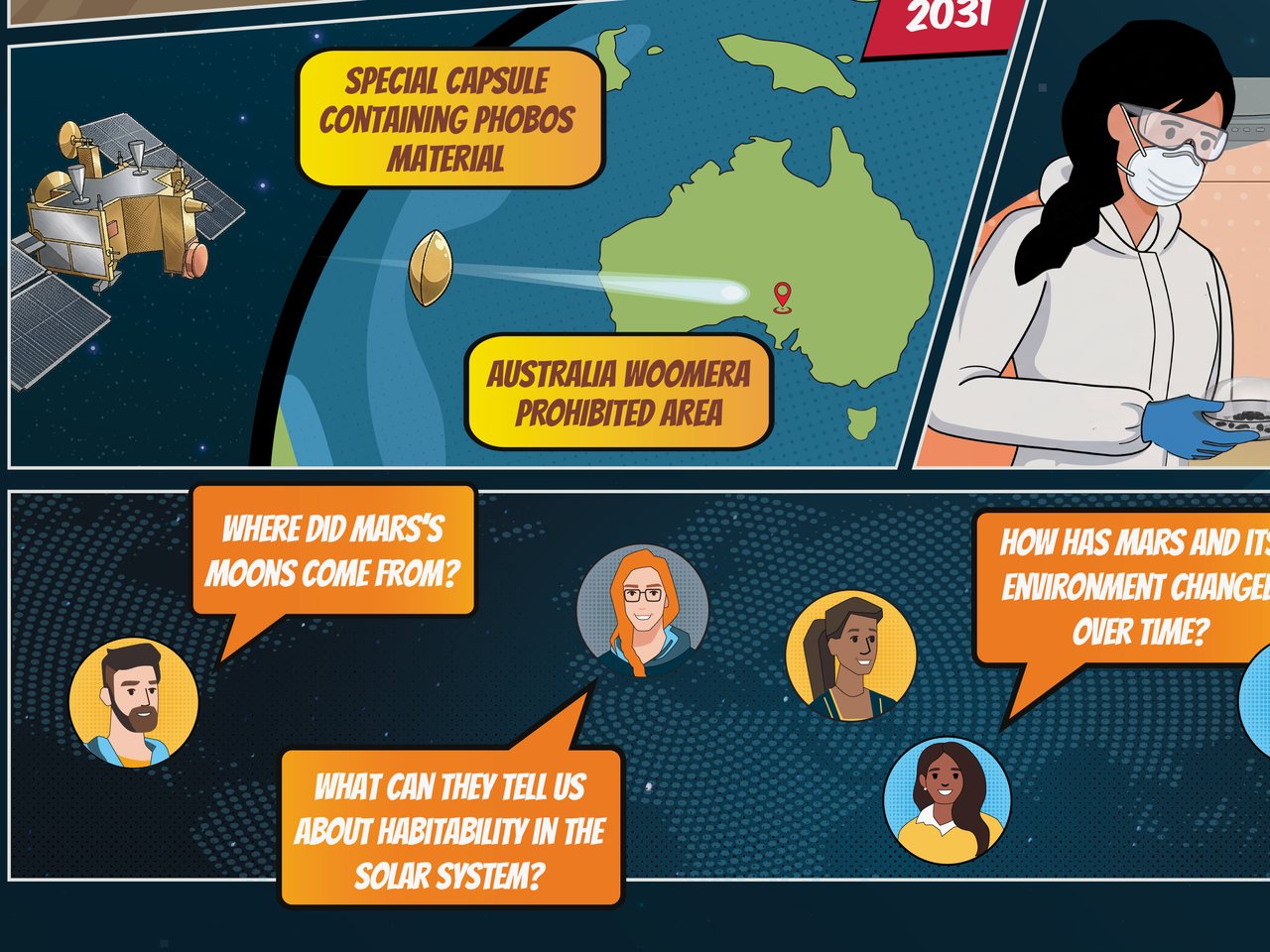
- A capsule carrying at least 10 grams of Phobos soil is due back in Australia in 2031.
Japan’s mission to collect the first samples from a moon of Mars is on its way. An H3 rocket carrying the Martian Moons eXploration (MMX) spacecraft lifted off from the Tanegashima Space Center in southern Japan in the early hours of Tuesday, in a launch window that opened at 4:41 am local time (1:11 am IST).
The Japan Aerospace Exploration Agency (JAXA) later confirmed that MMX had separated from the upper stage of the rocket, flight number 10 of the H3, and was on a trajectory towards Mars. Mitsubishi Heavy Industries builds and operates the H3.
What the mission will do
MMX is due to reach Mars in 2027 and spend about three years around its two small moons, Phobos and Deimos. Phobos, about 22 km across, is the main target. The spacecraft will map it, measure its gravity and composition, and then touch down twice to collect at least 10 grams of surface material.
Two tools will do the sampling. A corer on a robotic arm will dig material from about 2 cm below the surface, while a pneumatic sampler built by Honeybee Robotics, a company owned by Blue Origin, will use bursts of pure nitrogen gas to blow loose soil into a container.
Before that, MMX will drop IDEFIX, a four-wheeled French-German rover, which is expected to spend about 100 days exploring the surface of Phobos. Engineers designed it to cope with bouncing on landing and to right itself if it ends up upside down.
Why Phobos matters
Scientists still do not agree on where the moons of Mars came from. One idea is that they are asteroids captured by Martian gravity; the other is that they formed from debris thrown up when a large body struck Mars. A sample in a laboratory on Earth could settle the question, and JAXA says the mission’s goal is to “clarify the formation of the Martian sphere and the Solar System”.
The spacecraft has three modules for propulsion, exploration and the return trip, carries 11 instruments, and stands 5.3 metres tall. Its cost has been put at about $578 million.
What happens next
After several close flybys of Deimos, MMX is due to leave the Mars system in 2030. Its return capsule is expected to land in a remote part of Australia in 2031, completing what would be the first round trip to the neighbourhood of Mars and the first sample brought back from a moon other than Earth’s.
The documents
- JAXA press release, 20 October 2026JAXA, 20 October 2026